

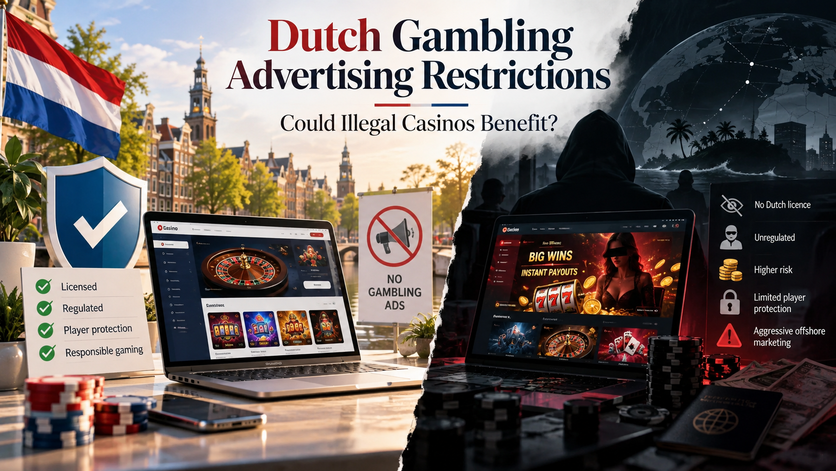
The Netherlands has spent the past few years steadily tightening the rules around gambling advertising. What started as an attempt to reduce aggressive marketing after the regulated online gambling market opened has developed into one of the strictest advertising environments in Europe.
The logic behind the restrictions is easy to understand. Gambling advertising can normalise betting, reach people who are vulnerable to addiction and, particularly in the case of younger adults, turn something occasional into something far more routine. But gambling regulation has an awkward habit of creating trade-offs. If licensed operators become almost invisible while offshore casinos remain aggressive on social media, search engines and other digital channels, the result may not be quite what policymakers intended. Players do not necessarily stop looking for gambling sites because legal brands advertise less. Some simply become more likely to encounter operators that do not have a Dutch licence. That raises an uncomfortable question for the Dutch market in 2026: could stricter gambling advertising rules unintentionally make life easier for illegal casinos? The answer is not a simple yes or no. There is evidence pointing in both directions, and that is precisely why the debate matters.The Netherlands has already gone much further than simple ad restrictions
The Dutch market changed dramatically after regulated online gambling launched in October 2021. Advertising from newly licensed operators appeared almost everywhere, and the sheer visibility of betting and casino brands quickly became politically controversial. Restrictions followed. Since July 2023, untargeted advertising for online gambling has been prohibited. That means licensed online operators cannot advertise through traditional mass-reach channels such as television, radio, newspapers, magazines, billboards and many public spaces. Digital advertising has not disappeared completely, but it is tightly controlled. Operators have to take measures to prevent their campaigns from reaching minors, young adults and other vulnerable groups. The Dutch regulator, the Kansspelautoriteit, or Ksa, issued additional guidance in March 2026 explaining how these obligations should be applied to online platforms and third-party advertising. The rules around sponsorship have tightened as well. A transition period ended on 1 July 2025, after which online gambling operators could no longer use sponsorship as a route to broad public exposure. Sports sponsorship is therefore effectively off the table for licensed online gambling companies. Influencers and other public personalities are another restricted area. In February 2026, the Ksa clarified that influencers, streamers, vloggers and similar online figures may fall under the role-model prohibition and cannot be used to promote online gambling. And the direction of travel is clear. In June 2026, the Dutch government announced plans to go further by introducing a complete advertising ban for online gambling, alongside measures such as a bonus ban, broader deposit limits and stronger enforcement against illegal operators. These measures are being developed into legislation, which means the proposed full advertising ban should not be confused with the restrictions that are already in force. That difference matters. The Netherlands is not currently operating under an absolute prohibition on every form of online gambling marketing. It is, however, moving closer to one.Why restrict gambling advertising in the first place?
There is a strong public-interest argument for doing so. Gambling is not an ordinary consumer product. An advert for a supermarket or streaming subscription does not carry the same potential financial and psychological risks as an advertisement encouraging someone to place bets or open a casino account. Reducing exposure can therefore be a legitimate form of player protection. This becomes particularly important when advertising repeatedly reaches people who never intended to gamble in the first place. A football fan should not necessarily have to watch gambling brands every time a match begins. A teenager scrolling through entertainment content should not be surrounded by betting promotions. Someone attempting to stop gambling should not constantly be reminded of it through ads. The Dutch government’s position is that previous restrictions have not gone far enough. When announcing its latest plans in June 2026, it pointed specifically to increased gambling participation and concerns about addiction, particularly among younger players. Seen purely from this perspective, reducing advertising makes sense. The difficult part begins when we look at what happens after legal advertising disappears.Legal casinos follow the rules. Illegal casinos do not.
This is the central problem. A company holding a Dutch gambling licence has something to lose. It can be investigated, sanctioned and ultimately risk its permission to operate if it repeatedly ignores advertising regulations. An offshore casino illegally targeting Dutch residents is working under a completely different set of incentives. It is already breaking Dutch rules simply by offering gambling services without the appropriate licence. Asking such an operator to respect Dutch advertising restrictions is unlikely to produce much cooperation. This creates an obvious imbalance. Licensed casinos become quieter. Illegal casinos do not. The scale of the problem is already visible. In May 2026, the Ksa reported that it had submitted more than 4,600 reports to Meta in April alone concerning illegal gambling advertisements appearing on Facebook and Instagram. The regulator said illegal operators were using aggressive social media advertising techniques and, in some cases, names or images associated with famous Dutch athletes and major brands to appear more trustworthy. That is not a theoretical future risk created by a possible full advertising ban. It is happening now.The visibility problem nobody can completely avoid
Imagine someone searches for an online casino in the Netherlands. Ideally, that person quickly encounters licensed operators, understands that they are regulated by the Ksa and can distinguish them from offshore alternatives. Advertising can play a role in that process. That may sound strange because advertising is usually discussed as a tool for encouraging gambling. Yet in a regulated market it can also serve another purpose: helping customers identify the legal part of the market. Remove too much legal visibility, and that distinction becomes less obvious. A licensed casino cannot simply copy the advertising strategy of an illegal competitor. It has age restrictions, targeting requirements, marketing rules, duty-of-care obligations and regulatory scrutiny to consider. The illegal competitor can be far less restrained. It may promise unusually large bonuses, advertise to people licensed operators are not allowed to target or promote features that would be unacceptable within the regulated Dutch system. For an experienced player, those differences may raise immediate red flags. For somebody who simply types “online casino Netherlands” into a search bar or encounters an advertisement in a social feed, they may not. That is where advertising restrictions can have unintended consequences.Even the Dutch regulator has warned about this trade-off
Interestingly, concern about the illegal market does not come only from gambling companies lobbying for looser marketing rules. Ksa chairman Michel Groothuizen addressed the issue directly in January 2026. He said the regulator was not in favour of a total advertising ban, arguing that operators need some ability to make themselves known; otherwise, there is a danger that the illegal market gains ground. That does not mean the Ksa supports unrestricted casino marketing. Far from it. The regulator has repeatedly emphasised stricter enforcement, better protection of vulnerable groups and responsible targeting. The point is more subtle: there is a difference between limiting harmful advertising and making legal operators almost impossible to identify. Finding the line between those two is considerably harder than simply banning more ads.The illegal market is already taking a surprisingly large share of the money
Dutch channelisation statistics make the discussion even more interesting. According to the Ksa’s spring 2026 monitoring report, around 91% of Dutch people who gamble online do so exclusively with legal providers. At first glance, that sounds encouraging. But measure the market by money rather than by player numbers and the picture changes considerably. The Ksa estimated monetary channelisation at approximately 53%. In other words, the legal market accounts for only slightly more than half of the relevant gambling expenditure measured through the regulator’s methodology. This gap is important. It suggests that most people may remain within the regulated system, while a smaller group using illegal casinos can account for disproportionately large amounts of gambling activity or losses. The Ksa itself has suggested that one explanation may be that people can lose considerably more money at illegal operators because those sites do not apply the same player-protection measures. That makes the debate about advertising much more than a dispute over marketing freedom. Channelisation is part of player protection. Getting someone to gamble with a licensed operator rather than an offshore site matters because the regulatory environment is different.Why illegal casinos may become more attractive
The word “attractive” needs some qualification here. Illegal casinos do not necessarily become better products because Dutch advertising rules get stricter. What can change is their relative visibility and the apparent freedom of their offers. A Dutch-licensed operator may face limitations relating to advertising, bonuses, deposit behaviour and intervention when a player’s gambling becomes risky. An offshore operator may advertise precisely the absence of those controls. That can appeal particularly strongly to high-risk players. Someone frustrated by limits or affordability checks may actively search for a casino that does not impose them. Someone registered with exclusion systems may look for alternatives outside the regulated market. And someone attracted primarily by aggressive promotional offers may find offshore advertising considerably louder than legal marketing. This is one of the paradoxes of gambling regulation: the players who most need protection may also be the ones most tempted by operators offering fewer protections. Advertising restrictions alone cannot solve that problem.Still, claiming that advertising bans automatically drive players offshore would be too simplistic
There is another side to the argument. Legal gambling advertising does more than identify regulated operators. It also recruits customers. That was one of the major criticisms following the opening of the Dutch online gambling market. A newly regulated industry suddenly had strong incentives to build brand recognition and acquire players quickly. Advertising became extremely visible. Reducing that exposure can mean fewer people begin gambling in the first place. If someone who never considered opening a casino account is no longer repeatedly shown betting promotions, the restriction may be doing exactly what it is supposed to do. There is also no guarantee that every player who stops seeing legal gambling advertisements will suddenly search for an unlicensed casino. Many will simply see fewer gambling messages. So the real policy question is not whether advertising restrictions are “good” or “bad.” It is whether the reduction in gambling exposure is large enough to outweigh any resulting loss of channelisation. That calculation is much harder.Search engines and social media are becoming the real battleground
Traditional television advertising is less relevant once it has been banned. Football-shirt sponsorship is less relevant once operators cannot use it. The contest increasingly moves online. Search results, affiliate websites, social networks, messaging platforms, influencers and algorithmic recommendations can all influence where players end up. This creates a major enforcement challenge. Removing one illegal casino website does not necessarily remove the business behind it. A new domain can appear. Advertising accounts can be replaced. Payment routes may change. Marketing affiliates can move traffic somewhere else. The Ksa acknowledged in 2026 that illegal businesses can disappear and reappear quickly. Its enforcement strategy has therefore increasingly focused on the wider infrastructure surrounding illegal gambling, including hosting companies, banks, payment providers and marketing businesses. The Dutch government also wants stronger tools, potentially including website blocking and clearer obligations for intermediaries that facilitate illegal gambling. That may turn out to be just as important as advertising policy itself. A country cannot realistically make legal gambling less visible while leaving illegal distribution channels untouched.The difference between “less advertising” and “less gambling”
These two ideas are easy to confuse. A government can reduce the number of gambling advertisements people see relatively quickly. Changing actual gambling behaviour is more complicated. Players who already gamble regularly know that online casinos exist. They do not need a billboard to remind them. For this group, restrictions on advertising may change which brands they recognise rather than whether they gamble at all. New or occasional players are different. Reducing their exposure may genuinely reduce participation or at least delay the point at which they start. This means the same advertising restriction can produce different effects depending on the audience. For one person, fewer advertisements means less temptation. For another, it means searching independently and potentially encountering an offshore operator. Good regulation has to account for both.Could illegal casinos benefit, then?
Yes — they could. But that does not mean stricter advertising rules are necessarily a mistake. Illegal casinos benefit when there is a visibility gap between regulated and unregulated operators. They also benefit when players find legal restrictions inconvenient and when enforcement against offshore alternatives is too slow to compensate. The current Dutch figures show why regulators are concerned. Player-based channelisation remains high, yet the share measured in monetary terms is far weaker. At the same time, thousands of illegal gambling advertisements are appearing on major social platforms. Those two facts should make policymakers cautious about assuming that restricting legal operators automatically shrinks the entire gambling market. Some activity can simply move.The Dutch market is entering its most difficult phase
The first stage of Dutch online gambling regulation was largely about bringing an existing offshore market into a licensed system. The next stage is more complicated. The Netherlands wants fewer people exposed to gambling, stronger player protection and tighter controls on licensed operators. At the same time, it needs licensed casinos to remain sufficiently visible and usable that players do not migrate towards unregulated alternatives. Those goals can conflict. A full advertising ban may reduce the normalisation of gambling and protect people who would otherwise be exposed to constant promotional messages. But if introduced without equally strong enforcement against offshore advertising, payment networks, affiliates and illegal websites, it risks creating an environment where responsible legal marketing disappears faster than irresponsible illegal marketing. That would be a poor outcome. The real test for Dutch policy will therefore not be how many casino advertisements disappear from view. It will be what happens to players afterwards. If fewer people gamble and those who continue overwhelmingly remain with licensed providers, the restrictions can reasonably be considered successful. If legal brands disappear from public view while offshore casinos gain traffic and a larger share of player losses, the Netherlands may discover that restricting an industry is much easier than controlling where its customers go. And that is why the question of illegal casinos cannot be treated as a footnote to the advertising debate. In 2026, it has become one of the central issues facing the Dutch regulated gambling market.

Collaboration Breakdown
Emily Carter
34%





Leave a Reply