


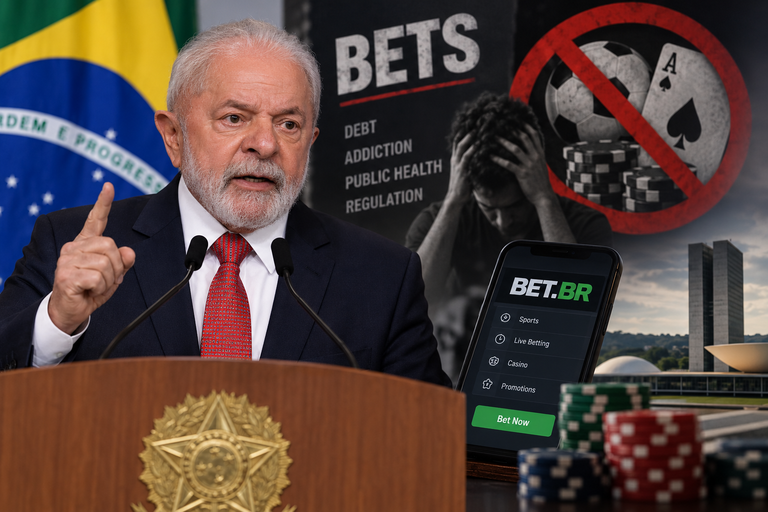
Brazilian President Luiz Inácio Lula da Silva has intensified his criticism of the country’s rapidly growing online betting industry, signalling that his government could consider much tougher measures against so-called “bets”. His latest comments mark another escalation in Brazil’s political debate over online gambling, player protection and the social costs associated with betting.
Speaking during a meeting with civil society representatives at the Palácio do Planalto on September 1, 2026, Lula said that he personally supports ending online betting operations in Brazil. He described betting platforms as harmful to society and said the government was considering what he called a “drastic decision” on the issue. However, Lula also acknowledged that any major policy change would have to take political, economic and social consequences into account.
Lula’s Position on Brazil’s Betting Market Becomes More Aggressive
Lula’s latest remarks are not an isolated criticism. In April 2026, the president had already publicly argued in favour of banning fixed-odds online betting, saying that if the decision depended solely on him, the betting platforms would be closed.
At the time, Lula linked his concerns mainly to household debt and the potential public-health effects of gambling addiction. He also stressed that a complete prohibition could not simply be introduced by presidential decision and would require coordination with Brazil’s National Congress.
By September, however, the tone had become noticeably stronger. Lula told representatives of civil society that the government had been discussing how to deal with the problem and that he believed a significant intervention might be necessary.
This creates growing uncertainty for an industry that only recently entered a fully regulated federal framework.
Brazil Only Recently Introduced a Regulated Online Betting Market
Brazil’s current betting framework is relatively new. Fixed-odds sports betting was originally legalised under Law No. 13,756 of 2018, while Law No. 14,790 of 2023 expanded and formalised the framework covering online games and betting operations.
Since January 1, 2025, only companies authorised by the Secretariat of Prizes and Betting, known as the SPA and operating under the Ministry of Finance, have been permitted to offer federally regulated fixed-odds betting in Brazil.
Licensed betting websites operating under federal authorisation use the .bet.br domain extension. Each federal licence may cover up to three betting brands.
The scale of the regulated market quickly became significant. According to the Brazilian Ministry of Finance’s 2025 management report, 79 companies were authorised during the year, representing 183 commercial brands. Those operators reported approximately 25.2 million Brazilian betting participants.
The same report states that roughly R$2.46 billion was collected through regulatory authorisation fees.
These figures illustrate why a possible ban or major restructuring would have substantial consequences both for gambling companies and for government revenue.
Player Debt and Gambling Harm Are Driving the Debate
One of Lula’s central arguments against online betting concerns its impact on household finances. The issue has received increasing political attention as studies and government programmes have highlighted problematic gambling behaviour.
A 2026 study conducted by researchers associated with Insper and Stone found significant financial deterioration among people who began gambling online. According to the research, bettors experienced higher levels of default and credit-card payment delays, while their available credit limits also fell after they started betting.
The study further reported that a large majority of bettors transferred more money to gambling platforms than they received back during the analysed period.
Concerns are no longer limited to personal finances. Brazil’s Health Minister Alexandre Padilha has argued that online betting should increasingly be treated as a public-health issue, comparing the regulatory challenge to the approach previously taken toward tobacco.
Government initiatives have already included gambling-related self-assessment tools, psychological support and a centralised self-exclusion system. More than 1.2 million people had reportedly used the self-exclusion platform by September 2026.
Brazil Has Already Tightened Enforcement Against Illegal Betting
Despite Lula’s increasingly critical language, the federal government has not simply abandoned regulation. During 2026 it also strengthened enforcement against operators acting outside the authorised market.
In June, Lula signed Decree No. 13,033/2026, establishing procedures that allow financial resources connected to illegal fixed-odds betting operations to be blocked.
The decree enables the Secretariat of Prizes and Betting to notify banks, payment institutions and payment-system operators when illegal gambling activity is detected. Financial accounts linked to unauthorised operators can subsequently be blocked, subject to administrative procedures and due-process guarantees.
This shows that Brazil is currently pursuing two parallel strategies: regulating and policing the legal market while simultaneously debating whether the social impact of online betting justifies even more radical restrictions.
A Complete Betting Ban Has Entered the Political Debate
Lula is not the only Brazilian political figure discussing prohibition.
In August 2026, Senator Carlos Fávaro introduced Bill PL 4977/2026, which proposes prohibiting the operation, promotion, advertising, sponsorship and intermediation of betting activities, including fixed-odds betting conducted both online and offline.
The bill would partially repeal the laws that currently provide the legal foundation for Brazil’s regulated betting market. As of September 2026, the proposal remains before the Senate and has not become law.
Other legislative initiatives are taking a more targeted approach rather than demanding a complete ban. Brazilian senators have also discussed tighter restrictions on gambling advertising, including potential limits affecting television, social media, football sponsorships, influencers and athletes.
These proposals indicate that even if Brazil does not completely prohibit online betting, operators could face a substantially stricter regulatory environment.
What Could Lula’s Criticism Mean for Brazil’s Gambling Industry?
For licensed operators, Lula’s comments increase regulatory uncertainty at a particularly sensitive time. Companies have already invested heavily in licensing, compliance systems, advertising and partnerships under the federal framework introduced in 2025.
An outright prohibition would therefore represent a dramatic reversal of the regulatory model.
A more probable intermediate scenario could involve tighter controls on advertising, stronger affordability and player-protection measures, stricter financial monitoring, broader self-exclusion requirements and tougher enforcement against unauthorised operators.
Any complete prohibition would also require significant legislative involvement. Lula himself has acknowledged that the executive branch cannot simply reshape the entire market without engaging Congress.
Brazil’s Gambling Regulation Is Entering a Critical Period
Brazil is therefore facing an unusual situation. The country has built one of Latin America’s most significant regulated online betting markets, yet political pressure against that same market is increasing less than two years after full federal regulation began.
The debate is no longer focused only on tax revenue and licensing. Household debt, gambling addiction, advertising exposure, consumer protection and the social role of betting have become central political issues.
Lula’s increasingly critical position suggests that the Brazilian gambling industry could face substantial changes. As of September 8, 2026, however, no nationwide ban on licensed online betting has been enacted, and authorised .bet.br operators can continue operating under the existing federal framework.
The next decisions from the government and Congress will therefore be crucial in determining whether Brazil maintains its regulated betting model, imposes much stronger restrictions or moves toward a broader prohibition.








James Anderson
This is an important development for Brazil’s gambling market. Lula’s growing criticism highlights the difficult balance between protecting consumers and maintaining a well-regulated legal market. Stronger measures against illegal operators, better enforcement and effective responsible gambling tools could be more productive than simply pushing players toward unregulated platforms. It will be interesting to see how the government’s position develops and what impact it has on the future of Brazil’s regulated iGaming sector.