


The online casino and iGaming industry is entering a new phase of consolidation in 2026. Major operators, technology companies and gaming groups are looking beyond organic growth and increasingly using mergers and acquisitions to expand into regulated markets, strengthen technology, acquire casino content and build scale.
Several major transactions announced during 2026 demonstrate just how significant the current M&A cycle has become. From the proposed €2.8 billion combination of Lottomatica and CIRSA to Fertitta Entertainment’s planned $17.6 billion acquisition of Caesars Entertainment, the year has already produced some of the industry’s most important transactions in recent memory.
2026 Has Changed the iGaming M&A Landscape
There are several reasons why mergers and acquisitions are becoming increasingly important in online casino and iGaming.
Regulated markets are becoming more competitive, customer acquisition costs remain significant, and operators need increasingly sophisticated technology, content and data capabilities. At the same time, established gaming companies have substantial financial resources and are looking for ways to increase their exposure to digital gambling.
The result is a market where companies are not simply buying competitors. They are also acquiring:
- online casino game studios;
- sportsbook and betting technology;
- iGaming platforms;
- established brands;
- regulated-market licenses and customer bases;
- data and technology capabilities;
- omnichannel gaming businesses.
This makes 2026 particularly interesting for investors, operators, suppliers and affiliates following the online casino sector.
Lottomatica and CIRSA: One of the Year’s Biggest Gaming Deals
One of the most significant announcements came on September 2, 2026, when Italy’s Lottomatica agreed to combine with Spanish gaming company CIRSA in an all-share transaction.
Reuters reported the transaction at approximately €2.8 billion, while the companies’ announcement described the combination as creating a major global gaming group. CIRSA shareholders are expected to receive 0.668 Lottomatica shares for each CIRSA share.
The combined company is expected to generate approximately €2 billion in pro forma adjusted EBITDA, while the companies forecast around €115 million in annual pre-tax synergies within three years.
Blackstone, CIRSA’s principal shareholder, is expected to hold approximately 24% of the combined group.
The transaction is particularly important because it demonstrates how gaming companies are using M&A to create scale across multiple regulated markets rather than focusing on a single country. Completion is expected in the second quarter of 2027, subject to shareholder and regulatory approvals.
Caesars Entertainment: A $17.6 Billion Takeover
Another enormous transaction reshaped the broader gaming landscape in May 2026.
Fertitta Entertainment agreed to acquire Caesars Entertainment in a transaction valued at approximately $17.6 billion, including around $11.9 billion of assumed debt.
The offer was made at $31 per Caesars share and represented a substantial premium to the company’s share price before the transaction was announced. The deal would take Caesars private if completed.
While Caesars is not purely an online casino company, its digital operations make the transaction highly relevant to the iGaming sector.
Caesars operates a major online betting and casino business, meaning the acquisition provides Fertitta with exposure to a large digital gaming operation alongside Caesars’ extensive land-based casino portfolio.
The transaction illustrates an important trend in 2026: the boundaries between traditional casinos, online casinos, sportsbooks, hospitality and gaming technology are becoming increasingly interconnected.
Evoke’s Takeover Shows Pressure on Mid-Sized Operators
Consolidation is not limited to the industry’s biggest companies.
In June 2026, British bookmaker Evoke agreed to be acquired by Bally’s Intralot in an all-share transaction valued at approximately £243 million ($326 million).
The offer valued Evoke at 52 pence per share, representing a 33.8% premium to its recent trading price. The transaction also included financing arrangements intended to refinance Evoke’s significant debt burden.
Evoke, formerly known as 888 Holdings, had acquired William Hill’s UK business from Caesars for approximately £2.2 billion in 2022. By 2026, higher UK gambling taxes and financial pressure had become important factors in the company’s strategic review.
This transaction shows why M&A can be attractive even when a company is not experiencing explosive growth. Scale, refinancing opportunities and operational efficiencies can make consolidation a strategic alternative to remaining independent.
Content Is Becoming an M&A Target
Not every important iGaming transaction involves a major casino operator.
Gaming content is increasingly valuable because online casino operators need exclusive and recognizable games to compete for players.
A good example is Merkur Group’s agreed acquisition of White Hat Studios, announced in July 2026.
White Hat Studios launched in 2021 and became a significant supplier to the regulated U.S. iGaming market. Merkur said the company was the first to launch online slots across all seven regulated U.S. iGaming states.
The studio has more than 150 titles and operates the Jackpot Royale progressive network, with more than 40 jackpot games contributing to local operator progressive pots.
The acquisition does not include White Hat Gaming’s platform and white-label businesses, which remain under their existing ownership. The transaction is also subject to regulatory approval.
This is significant because it shows that M&A is increasingly being used to acquire specialized casino content, rather than simply purchasing complete online casino operators.
Technology Is Another Major Driver
The iGaming industry is also seeing companies acquire technology rather than consumer-facing casino brands.
In August 2026, Tabcorp agreed to acquire wagering technology company BetMakers in a transaction valued at approximately A$267 million.
The deal is designed to support Tabcorp’s technology transformation, with expected synergies of around A$30 millionand potential double-digit earnings-per-share growth by the third year, according to reporting on the transaction.
Although BetMakers is focused heavily on wagering technology rather than online casino alone, the transaction highlights the broader technology race taking place across the gambling industry.
Platforms, data, automation, payments and customer-management systems are becoming strategic assets.
Why Regulated Markets Matter So Much
One of the clearest themes in 2026 M&A is the importance of regulated markets.
Entering a regulated market from scratch can require significant investment in licensing, compliance, technology, marketing and customer acquisition.
Acquiring an established business can provide an alternative route.
This explains why U.S. iGaming assets remain attractive. White Hat Studios, for example, had already established distribution across all seven U.S. states with regulated online casino markets at the time Merkur announced its acquisition.
For larger companies, acquiring an established supplier or operator can therefore provide immediate market access and an existing product portfolio.
Strong Businesses Are Still Investing
The financial results of major iGaming companies also show why strategic acquisitions remain possible.
BetMGM reported $2.796 billion in 2025 net revenue, representing a 33% increase year over year. Its iGaming net revenue reached $1.827 billion, up 24%, while adjusted EBITDA improved to $220 million from a $244 million loss in 2024.
For 2026, BetMGM initially guided toward $3.1-$3.2 billion in revenue and $300-$350 million in adjusted EBITDA. By July, however, the company said it expected results toward the lower end of those ranges amid increasing competition and regulatory complexity.
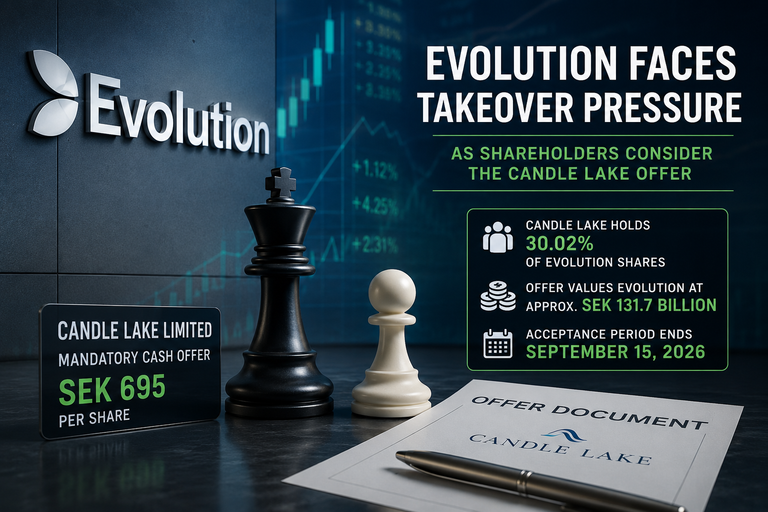
Evolution also remains one of the most financially significant suppliers in the industry. For the first half of 2026, the company reported €1.031 billion in net revenue and €676.3 million in EBITDA, with an EBITDA margin of 65.6%.
These figures demonstrate why successful B2B suppliers and technology companies can become attractive M&A targets.
Not Every Deal Gets Completed
An important point about the 2026 M&A market is that announced transactions are not guaranteed to close.
Evolution’s planned acquisition of Galaxy Gaming is a useful example.
The companies had entered into a merger agreement, but Evolution terminated the agreement in July 2026. According to the SEC filing, Evolution was required to pay Galaxy Gaming a $5.23 million termination fee.
This is an important reminder that regulatory approvals, financing, valuation and changing market conditions can all affect whether an announced deal ultimately becomes a completed acquisition.
For investors and industry observers, therefore, the distinction between announced, pending and completedtransactions is critical.
What Does This Mean for Online Casinos?
The current M&A environment could have several consequences for online casino players and operators.
1. Larger Casino Groups
Consolidation can create larger companies with more resources for marketing, technology and product development.
2. More Exclusive Casino Content
Acquiring game studios gives operators and suppliers greater control over casino content and intellectual property.
3. Increased Competition for Technology
As companies acquire platforms, data and technology businesses, technological capabilities are likely to become an even more important competitive advantage.
4. Greater Focus on Regulated Markets
Companies increasingly want assets that already operate legally in established jurisdictions rather than relying exclusively on speculative market expansion.
5. More Consolidation Ahead
The 2026 deals suggest that the industry may not be finished consolidating. Companies with strong technology, recognizable casino brands, regulated-market access or valuable game portfolios could continue to attract strategic buyers.
What Affiliates Should Watch in 2026
The M&A trend is also important for the affiliate marketing industry.
When an online casino operator is acquired, its brand strategy, affiliate programme, tracking platform, commission structure or market priorities can potentially change.
Affiliates should therefore pay attention not only to new casino launches but also to corporate ownership.
A change in ownership can affect:
- affiliate terms and commissions;
- payment schedules;
- available GEOs;
- responsible gambling requirements;
- brand positioning;
- marketing budgets;
- SEO strategies;
- acquisition priorities.
For affiliates working in competitive iGaming markets, understanding the ownership structure behind an online casino can therefore be just as useful as knowing its bonus offer or game portfolio.
The Bigger Picture: Why 2026 Matters
Calling 2026 a major year for iGaming M&A is not based on a single transaction.
The year has produced large-scale activity across several parts of the gambling ecosystem.
Lottomatica’s proposed €2.8 billion CIRSA combination, Fertitta’s approximately $17.6 billion Caesars acquisition, Evoke’s £243 million takeover, Merkur’s acquisition of White Hat Studios and Tabcorp’s approximately A$267 million BetMakers deal demonstrate different forms of consolidation across operators, suppliers and technology businesses.
At the same time, the termination of the Evolution-Galaxy Gaming merger shows that not every transaction will reach completion.
The common thread is clear: scale, regulated-market access, technology, content and operational efficiency are becoming increasingly valuable strategic assets.
Final Thoughts
The online casino and iGaming industry is becoming more mature, more regulated and more competitive. In that environment, mergers and acquisitions offer companies a way to expand faster, enter established markets and acquire technology or content that would take years to develop internally.
The transactions announced in 2026 suggest that consolidation is no longer limited to traditional casino operators. Game studios, technology providers, digital platforms and established online brands are all becoming potential M&A targets.
If the current pace continues, 2026 could ultimately be remembered as one of the defining years for consolidation in the modern iGaming industry.










Daniel Bennett
Very interesting overview of the iGaming M&A landscape in 2026. What stands out is that consolidation is no longer limited to large casino operators, with technology, game studios, platforms and access to regulated markets becoming equally valuable assets. The point about not every announced deal reaching completion is also important for investors and industry observers. It will be interesting to see how much further this consolidation trend develops over the coming months