

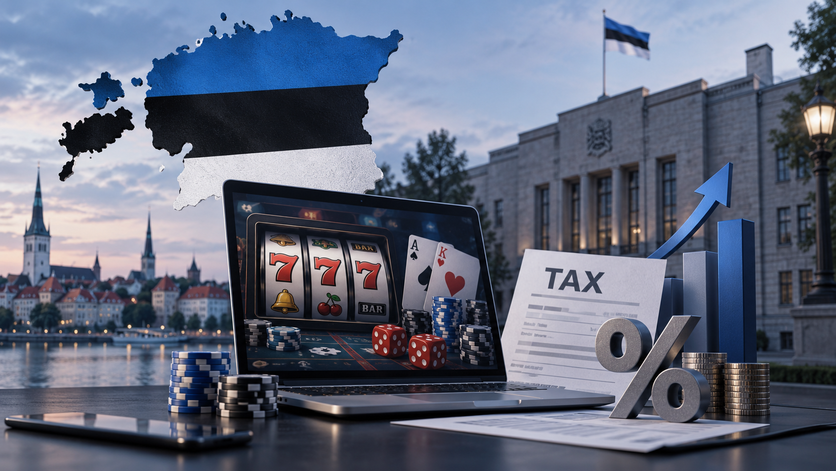
Estonia is once again reviewing the direction of its iGaming tax policy, only months after introducing a lower tax rate for remote gambling operators. A new proposal submitted to the Riigikogu, Estonia’s parliament, seeks to reverse the recently introduced tax reduction and restore the rate applied to online gambling to 7%.
The proposal adds a new chapter to Estonia’s evolving approach to gambling taxation and could have significant implications for online casino operators, investors and companies considering the country as a base for regulated iGaming activity.
Estonia’s iGaming Tax Policy Could Change Again
On September 2, 2026, the Isamaa parliamentary group submitted a bill proposing changes to Estonia’s Gambling Tax Act. The proposal was formally accepted for parliamentary proceedings on September 3.
According to the Riigikogu, the bill would cancel the tax reduction previously granted to online casinos and restore the earlier tax level. Under the proposal, the gambling tax rate for relevant remote gambling activities would be set at 7%.
The initiative is particularly notable because Estonia had only recently moved in the opposite direction. From 2026, the country introduced a plan to gradually reduce taxes on remote gambling in an effort to reshape its regulatory environment.
How Estonia’s Current Remote Gambling Tax Works
Estonia’s current gambling tax framework introduced a 5.5% remote gambling tax rate in 2026. The tax generally applies to the amount received from bets after player winnings have been deducted.
The Estonian Tax and Customs Board confirms that the 2026 rate for relevant forms of remote gambling is 5.5%.
The change formed part of a broader plan under which the rate was intended to fall by 0.5 percentage points each year. Estonia’s Ministry of Finance previously confirmed that the reduction would begin in 2026.
Under the legislation already adopted, the scheduled structure includes:
- 2026: 5.5%
- 2027: 5%
- 2028: 4.5%
- 2029: 4%
The official legislation confirms a 5% rate from January 1, 2027, while the planned rate for 2029 is 4%.
The new proposal could therefore represent much more than a minor adjustment. If approved in its current form, it would effectively reverse the broader strategy of progressively reducing Estonia online gambling tax rates.
Why Was the iGaming Tax Reduced?
The original tax reduction was designed to make Estonia’s regulated gambling environment more competitive.
Lower taxation can potentially encourage international operators to obtain local licences, establish operations in Estonia or expand existing activities within the regulated market. A more competitive rate may also increase the attractiveness of Estonia compared with other European iGaming jurisdictions.
The strategy reflects a wider challenge facing gambling regulators across Europe: governments need to balance tax revenue with market competitiveness.
If taxes are considered too high, licensed operators may find a jurisdiction less commercially attractive. However, reducing rates also creates uncertainty about whether additional market activity will generate enough revenue to offset the lower percentage collected from individual operators.
Estonia’s latest proposal indicates that this balance remains politically contested.
Why Is Estonia Considering a Return to 7%?
The new bill specifically proposes cancelling the tax reduction granted to online casinos and restoring the tax rate to 7%.
At this stage, however, the proposal should not be treated as an already approved tax change. It has entered the legislative process and must still pass the necessary parliamentary stages before becoming law.
This distinction is important for operators following Estonia gambling regulation. The current 2026 tax framework remains in place unless parliament approves further amendments.
The discussion is nevertheless significant because it suggests that policymakers are reconsidering whether progressively lower gambling taxes provide sufficient benefits for Estonia.
Revenue considerations are likely to play an important role in the wider political debate. Gambling tax revenue contributes to Estonia’s state budget, with legislation also linking part of the expected revenue to cultural funding.
Estonia Has Already Faced Gambling Tax Complications in 2026
The latest debate follows an unusual start to Estonia’s new gambling tax system.
Earlier in 2026, lawmakers had to correct a technical error in the Gambling Tax Act that created uncertainty over the taxation of online games of chance. The wording of the legislation initially referred incorrectly to remote games of skill, creating a potential gap affecting online casino taxation.
The Riigikogu subsequently approved an amendment ensuring that games of chance and games of skill organised as remote gambling would be taxed uniformly at 5.5%. The correction entered into force on March 1, 2026.
That amendment restored legal clarity, but the September proposal means the sector could now face another important legislative change within the same year.
What Would a 7% Tax Mean for iGaming Operators?
A return to a 7% iGaming tax rate would increase the tax burden compared with Estonia’s current system and would be considerably higher than the 4% rate originally scheduled for 2029.
For licensed operators, taxation is one of several factors influencing market strategy. Companies must also consider licensing requirements, compliance expenses, payment infrastructure, responsible gambling obligations and the size of the domestic market.
A higher tax rate does not automatically make a jurisdiction unattractive. However, predictability is particularly important for businesses making long-term investment decisions.
Frequent changes to tax policy can make financial planning more difficult, especially for operators evaluating whether to enter a market or expand their presence.
For Estonia, the central question may therefore extend beyond whether the correct rate is 4%, 5.5% or 7%. Regulatory stability itself could become an important factor in how international iGaming companies assess the market.
Could the Tax Change Affect Estonia’s iGaming Competitiveness?
Estonia has developed a reputation as a digitally advanced European economy, and its technology-friendly environment can be attractive to online businesses.
The planned gambling tax reductions appeared consistent with an effort to strengthen Estonia’s position within the international iGaming industry.
Reversing those reductions could change that calculation.
A 7% rate would still need to be considered alongside the overall regulatory framework rather than in isolation. Licensing accessibility, compliance standards, corporate taxation, banking infrastructure and access to European markets can all influence where gambling businesses choose to operate.
Nevertheless, taxation remains one of the most visible competitive factors between regulated gambling jurisdictions.
Operators considering Estonia will therefore be watching the parliamentary process closely.
What Happens Next?
The proposal has been assigned to the Riigikogu’s Finance Committee, which will play an important role in the next stages of consideration.
The bill may be debated, amended, approved or rejected as it moves through parliament. Until that process is completed, Estonia’s existing remote gambling taxation rules remain the relevant framework.
The key issue to watch is whether lawmakers ultimately support the planned long-term reduction in remote gambling tax, modify it or abandon it entirely in favour of the proposed 7% rate.
Estonia’s Gambling Tax Debate Is Far From Over
The latest proposal highlights how quickly European iGaming regulation can change.
Estonia entered 2026 with a strategy of progressively reducing remote gambling taxes, starting with a 5.5% rate and eventually targeting 4% by 2029. Less than a year later, lawmakers are now considering a proposal that would reverse that direction and restore a 7% rate.
For operators, affiliates and other businesses connected to the Estonian gambling market, the development is worth following closely. The final decision could influence Estonia’s tax revenues, regulatory positioning and attractiveness as an iGaming jurisdiction.
For now, the proposed increase remains exactly that: a proposal. The next stages of the parliamentary process will determine whether Estonia continues with its planned tax reductions or adopts a substantially different course.








Leave a Reply